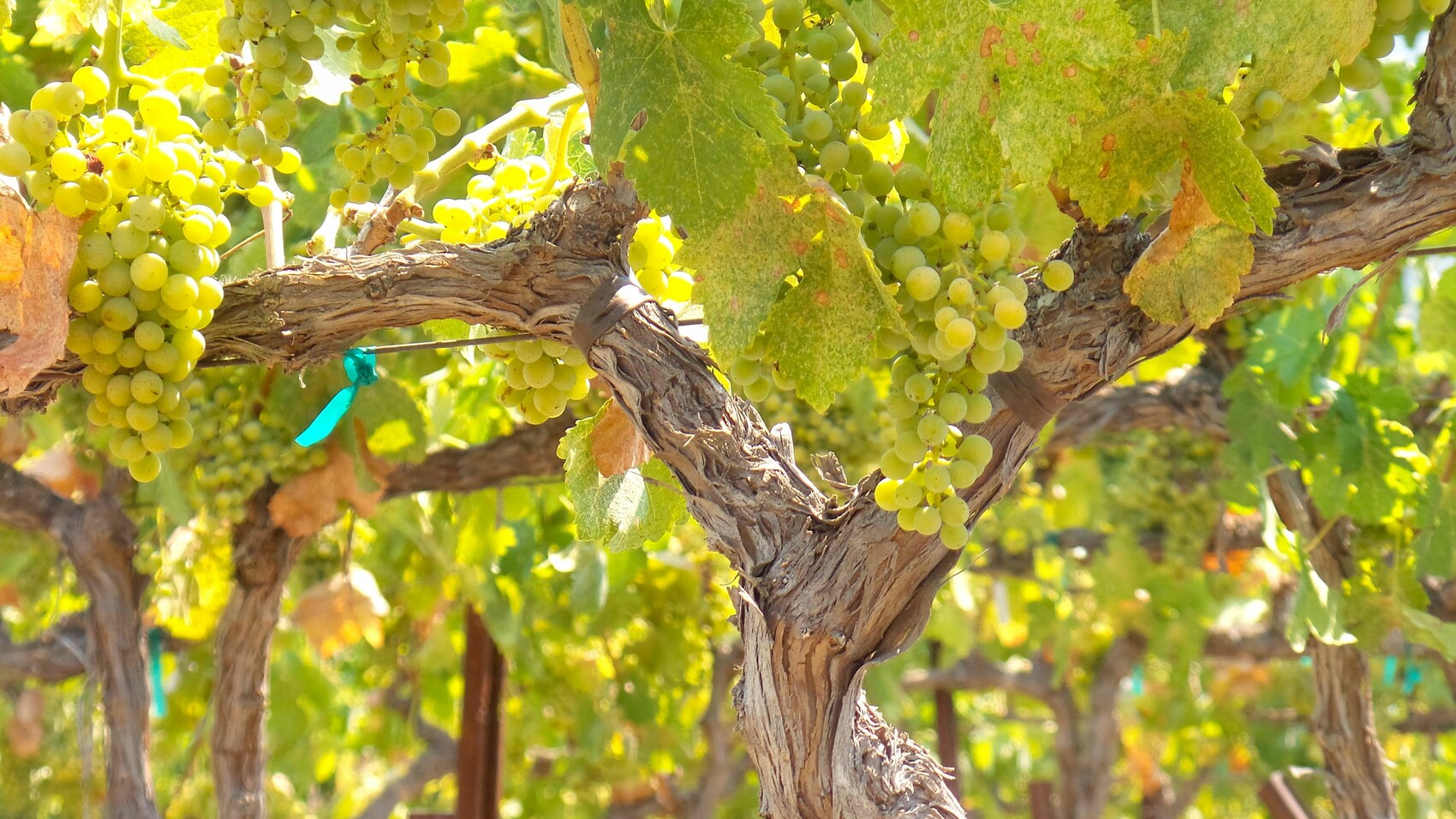
Viognier
Viognier (pronounced VEE-ohn-yay) is the most-planted white Rhone varietal in the United States, and produces wines with intense aromatics of peaches, apricots, and violets, as well as viscosity and lushness on the palate. At Tablas Creek, it takes the lead in our Côtes de Tablas Blanc, an important secondary role in our Patelin de Tablas Blanc, and in many years a lovely varietal wine.

Early History
Viognier is historically grown in the Northern Rhône valley, and reaches its peak in the tiny appellations of Condrieu and Château Grillet. The precise historical origin of the varietal is unknown, but many believe it dates back to the Roman Empire. According to one story, Emperor Probus imported Viognier into Condrieu from Dalmatia (in present-day Croatia) in 281 AD as a means of replacing the vineyards destroyed by Emperor Vespasian. Legend has it that Vespasian tore up the Condrieu vineyards after the locals revolted, a revolt which he attributed to drinking too much of the native wine.
Regardless of how the varietal originally arrived in Condrieu, historical records confirm that Viognier was grown in the area during the Roman Empire. When the Romans were forced out of Gaul in the 5th Century, the vines remained uncultivated for centuries but were revived by locals in the 9th Century. The varietal spread to neighboring Château Grillet, and from there to the papal palace at Avignon in the 14th Century.
Viognier's Decline and Recovery
By the 1960's, Viognier plantings had diminished dramatically, down to an estimated 15 acres in Condrieu and little more elsewhere in the Rhone Valley. But it exploded in popularity beginning in the 1970's, and as of 2016 accounts for some 40,000 acres worldwide, including more than 20,000 acres in France, and significant plantings in Italy (4,500 acres), the United States (2,400 acres), and roughly 2,000 acres each in South Africa, Chile, Australia and Argentina. The 2,400 acres of Viognier in California as of 2025 make it by far the most planted white Rhone variety here, with roughly double the acreage of the other white Rhone grapes combined.
Viognier in California
American growers, led by pioneers such as John Alban, Josh Jensen of Calera, and Joseph Phelps, brought Viognier into the United States in small quantities in the late 1980s. Almost simultaneously, other American growers brought over what they thought were Roussanne cuttings from the Rhône Valley, which were then propagated and planted in vineyards around California. Years later, in 1998, those vines were identified as Viognier, not Roussanne – a discovery which added a new Viognier clone for California producers to work with. We contributed two new clones, imported from Château de Beaucastel.
Viognier in the Vineyard and Cellar
Viognier is a reasonably difficult grape to grow, as it is somewhat more prone to disease than other varietals and can be unpredictable in its yield. It is, however, reasonably drought resistant, enabling it to thrive in the dry Paso Robles summer climate. It flowers and ripens early, and is usually the first grape we harvest in late August or early September. Because Viognier flowers so early in the season, it is susceptible to spring frosts, and its production was decimated in 2001, 2009, and 2011. We have installed frost-protection fans in our largest Viognier block, which help most years.
The vines have medium-sized leaves, with small clusters of small, deep yellow berries that produce straw-gold colored wines. On the roughly six acres we have in production, we've averaged just over 16 tons in production since 2006, about 2.8 tons per acre. Viognier makes up roughly 15% of our white Rhône production.
We typically ferment Viognier to emphasize its freshness rather than its richness. It naturally ripens with relatively high sugars and low acidity, so we ferment it in stainless steel, and look to blend it with lots that have good minerality, bright acidity and low alcohol. Our most frequent partners for our Viognier are Marsanne (for minerality and elegance) and Grenache Blanc (for acidity). These three varieties, plus brighter, leaner lots of Roussanne, make up our Cotes de Tablas Blanc each year. In our Patelin de Tablas Blanc, which is based on the bright acids and rich mouthfeel of Grenache Blanc, Viognier contributes floral aromatics and stone fruit flavors. We have also bottled a varietal Viognier about two-thirds of our vintages since 2003.
Flavors and Aromas
Viognier's powerful aromas of peaches, apricots, and violets make it one of the world's most recognizable grape varieties. In the mouth, it shows great richness, flavors of stone fruit and honey, and a long finish. It is typically best drunk young.
This article originally appeared in one of our newsletters. Each newsletter, we spotlight the history and characteristics of one of our Rhone varietals. You can sign up for our mailing list.
You can view a one-minute summary of Viognier on our YouTube page.
You can go back to the summaries of the different Rhône grape varietals.