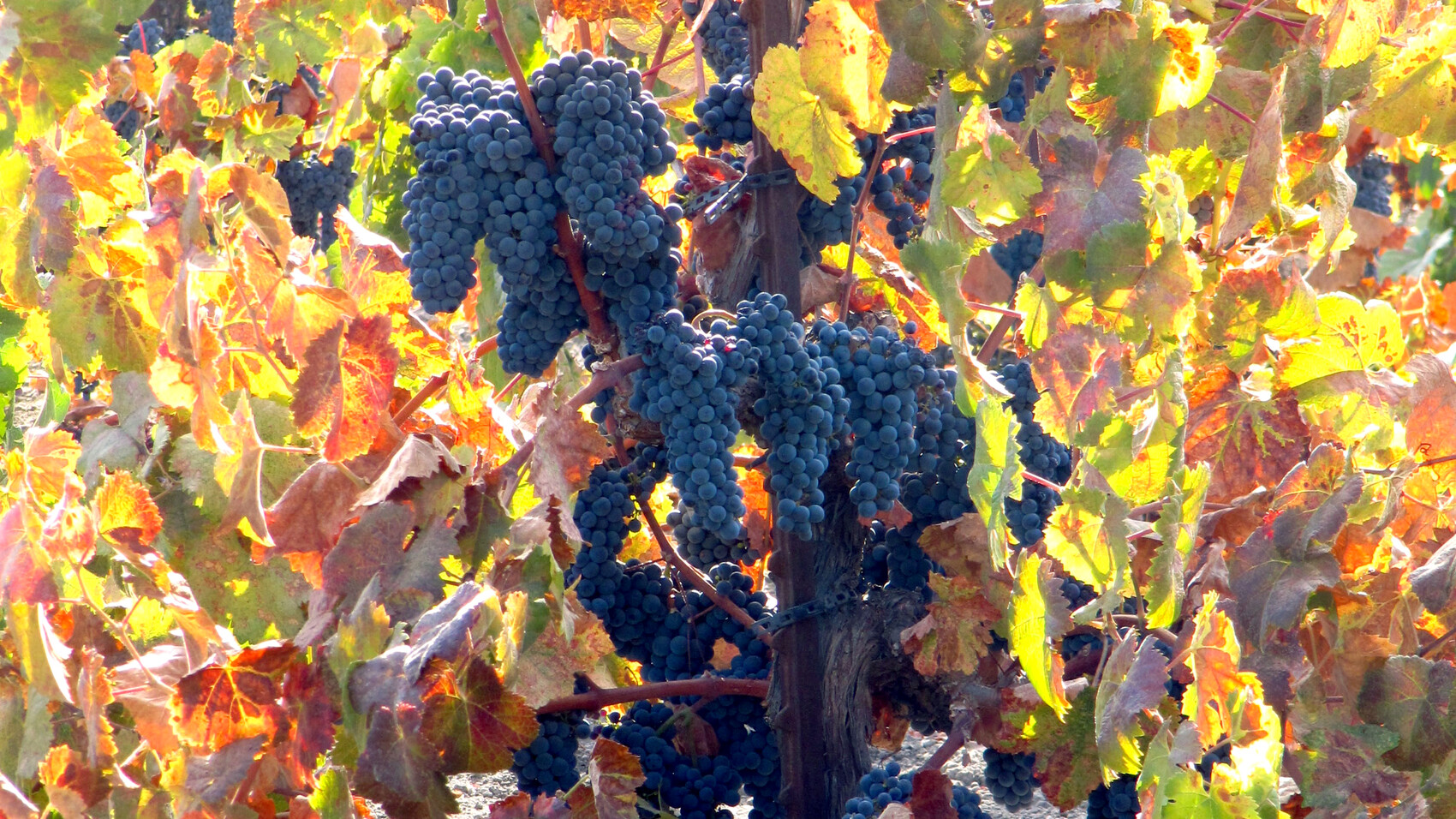
Tannat
Although we specialize in Rhône grape varieties, we continue to experiment with other grapes that we feel might thrive in the shallow rocky soils and dramatic summer climate of Tablas Creek. Tannat is one of these grapes, and its intense fruit, spice and powerful tannins combine to make remarkable wines here, in a distinctly different style than our Rhone grape varieties.

Early History
Though many scholars believe Tannat originated in the Basque region, Tannat is most closely associated with the winemaking region of Madiran, at the foothills of the Pyrenees Mountains in southwestern France. The grape has been grown in that region for centuries, and 17th and 18th century
French kings accepted Madiran wines as payment for taxes. Madiran appellation laws mandate that Tannat be blended with Cabernet Sauvignon or Cabernet Franc, but producers have recently begun receiving notable press for their 100% Tannat Madiran wines.
Tannat continues to be grown in the Basque country, most notably in the tiny appellation of Iroulèguy, on the Spanish border. In 1870, Basque immigrants brought the grape to Uruguay, where it adapted perfectly to the local soil and climate. It has since become the national red grape variety of Uruguay, accounting for approximately one third of all wine produced in that country; more Tannat is grown in Uruguay than in the varietal’s native France.
Tannat at Tablas Creek
We did not originally intend to produce a Tannat. In fact, the Perrins’ French nurseryman included Tannat cuttings of his own volition when he also packed up the Rhone varieties we'd asked for in 1990. These cuttings were entered into quarantine at the USDA station in Geneva, New York and it was a couple of years before we untangled the mystery of how this non-Rhone grape came to be under our account with the USDA. When we traced it back to the nurseryman we asked him why he'd included this (to us) unrelated grape. His response was "I know this grape, and from what I've learned about Paso Robles, it should grow well there. You should try it." When in 1993 the Tannat cuttings were declared virus free and released to us, we decided that with little of our vineyard yet planted we might as well see if he was right. In 1996 we planted just under an acre, and while we received a tiny production that was tossed in at harvest with other varieties starting in 2000, we first harvested enough to ferment on its own in 2002.
In the vineyard, Tannat is one of the easiest varietals to grow. It is frost hardy and a solid producer whether trellised or head-pruned. Yet unlike many other red grapes (most notably Grenache) it is not prone to overproduction, and we do not have to thin the shoots to keep production down. Its berries have thick skins, which make it resistant to powdery mildew and botrytis. It ripens in the middle of the ripening cycle, typically in late September or early October, and we can harvest it nearly every vintage at numbers that we consider ideal: around 24° Brix and a pH of around 3.3. The sole difficulty with growing Tannat is its thick stems, which cling tightly to the berries and can be difficult to de-stem at harvest.
Tannat is quite tannic (due in part to the berries’ thick skins), and we ferment it in open-top tanks to expose the juice to more oxygen and soften the tannins. We age Tannat in small (usually neutral) barrels to expose the juice to some oxygen in the aging process. We typically either co-ferment or blend into our Tannat our small nursery parcel of Cabernet Sauvignon. In France, Cabernet is traditionally added to Tannat to open it up and make it more approachable. That fact alone should give you a sense of just how powerful Tannat can be. But the grape gets riper here in Paso Robles than it does elsewhere in the world, while still maintaining its wonderful structure.
Because of our enthusiasm for the grape's potential, we have since 2002 planted two more parcels to Tannat, and now have a total of 3.5 acres at Tablas Creek, off of which we harvest on average 10 tons of fruit per year.
Tannat and the BATF
Although Tannat had existed in the University of California’s vine collections since the 1890s, when we began growing Tannat it had not yet been recognized by the Bureau of Alcohol, Tobacco and Firearms.
When we decided to bottle it, we petitioned the BATF to recognize Tannat as a separate varietal, a process we had recently undergone with both Grenache Blanc and Counoise. We amassed literature on Tannat to demonstrate it was a recognized varietal in other countries, and compiled descriptions of its characteristics to show that it had positive value as a wine grape in the United States. In September of 2002, our petition was formally approved.
As of 2025, there were 573 acres of Tannat planted in California, most from Tablas Creek cuttings, with the majority of that acreage planted in the fist half of the 2010s.
Aromas and Flavors
Tannat makes decidedly robust wines, with pronounced aromas of smoke and plum, significant tannins and a wonderfully spicy finish. Here at Tablas Creek, we’ve found the wines to be dense purple-red in color, with a nose of tobacco, smoke, and ripe berries. The rich palate has juicy flavors of plum and raspberry, with a long, generous finish. The tannins are impressive, but nicely balanced with the intense fruit and spice flavors of the wine. Unlike most Old World examples, you can enjoy our Tannats young, but we believe that they benefit from three to five years of bottle aging and should evolve gracefully for two decades. As for food pairings, Tannat's smoky character makes it a perfect match for roasted meats and game, as well as sausages and strong aged cheeses.
In addition to bottling Tannat as a varietal wine each year since 2002, we have included it in our En Gobelet blend of head-trained, dry-farmed vineyard blocks most years since the wine debuted in 2007. There, Tannat's firm structure and smoky minerality balance the relative opulence of Grenache and Mourvedre, and it assumes the role typically played by Syrah -- which does not head-train well -- in the southern Rhone.
Tannat and Health
Recent research, led by Dr. Roger Corder (a cardiovascular expert at the William Harvey Research Institute in London) makes the case for oligomeric procyanidins (OPCs) as the source of red wine’s health benefits. All red grapes, particularly those with thick skins and high skin-to-pulp ratios, contain OPC’s. But, after measuring the OPC concentration of several common red wine grapes, Dr. Corder identifies Tannat as the grape with the greatest concentration. The real-life evidence of Tannat’s benefits can be seen in the surprisingly long lifespans of residents of the département of Gers in southwest France, whose local wine appellation is Madiran. Gers contains more than double the national average of men in their nineties. Madiran’s principal grape is Tannat. You can read a detailed analysis of the link between Tannat, heart health and longevity on the Tablas Creek blog.
This article originally appeared in one of our newsletters. Each newsletter, we spotlight the history and characteristics of one of our Rhone varietals. You can sign up for our mailing list.
You can view a one-minute summary of Tannat on our YouTube page.
You can go back to the summaries of the different Rhône grape varietals.