Picpoul Blanc
Picpoul Blanc (also spelled Piquepoul Blanc) is one of the lesser-known Rhône varieties, but one that we think has a tremendous future in California. It is one of the six white grapes allowed in Châteauneuf-du-Pape, where it is used primarily for its acidity. Like the better known Grenache and Pinot, Picpoul has red, white and pink variants, though Picpoul Noir and Picpoul Gris are rare. Literally translating to “lip stinger”, Picpoul Blanc produces wines known in France for their bright acidity, minerality, and clean lemony flavor.
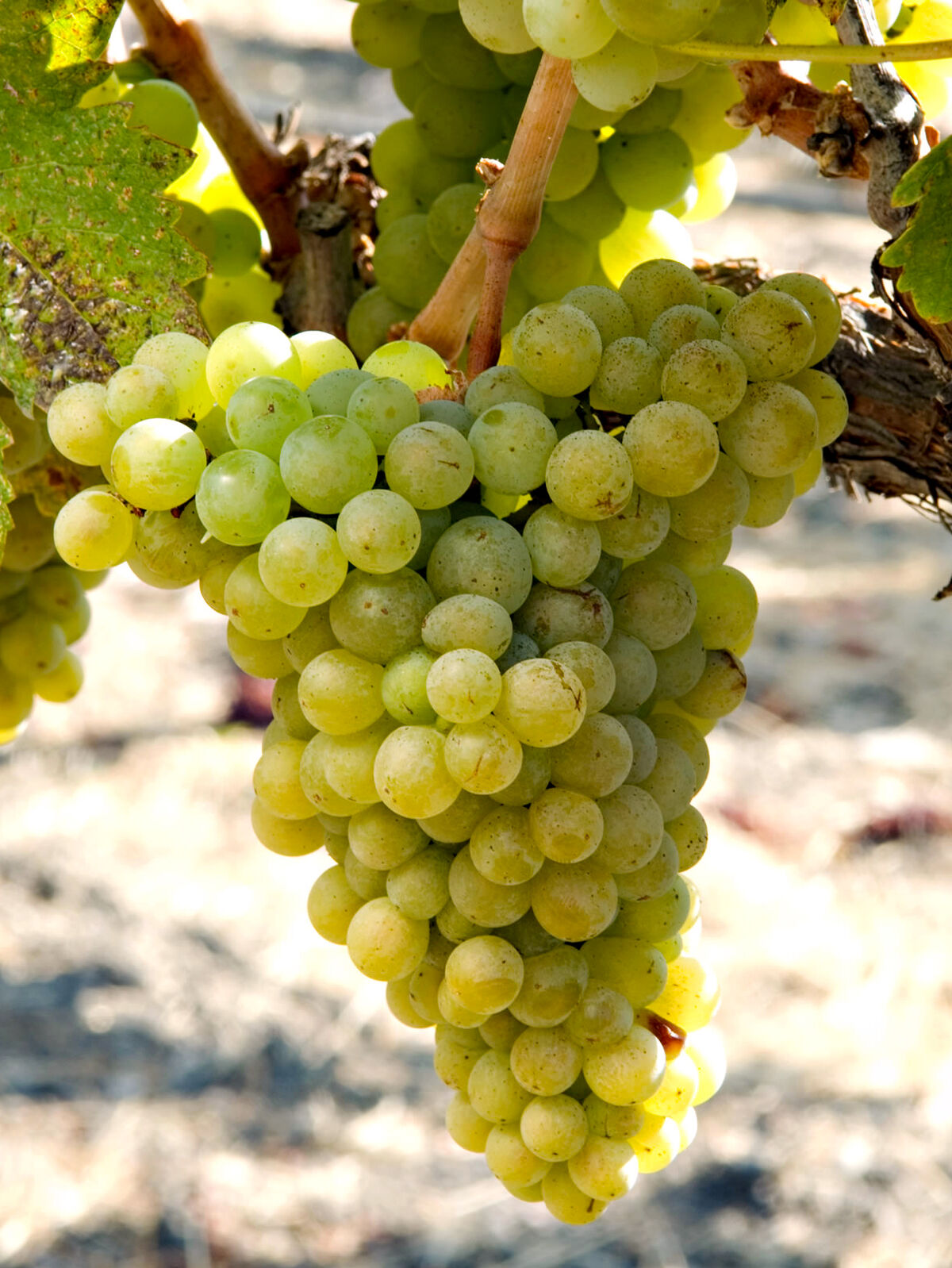
Picpoul in France
Most scholars believe Picpoul is native to the Languedoc region of Southern France, where it is still found today. Records from the early 17th century indicate that it was blended with Clairette (another white Rhône varietal) to form the popular sweet Picardan wine (not to be confused with the Châteauneuf du Pape varietal of the same name) which was exported by Dutch wine traders from Languedoc throughout Northern Europe in the 17th and 18th centuries. After the spread of phylloxera at the end of the 19th century, Picpoul was not widely replanted, and it's only in the last few decades that it has seen a resurgence of interest.
Today the roughly 3,800 acres in France are centered around the village of Pinet in the Côteaux de Languedoc, whose Picpoul de Pinet wines are the grape's best-known, and which are famously good with oysters. Just a dozen acres are planted in Chateauneuf-du-Pape. There are 82 acres in California as of 2025, all from Tablas Creek cuttings, with small additional plantings in Washington State and Texas.
Picpoul at Tablas Creek
We did not import Picpoul with our initial eight varieties in 1989. After the original eight were established in the vineyard, we decided that the consistent sun and long growing season at Tablas Creek might prove to be well-suited to grapes that in France are lean and high in acidity. Picpoul, with its reputation for sharp acidity, was the first of these high-acid whites that we brought into quarantine, and was in fact the first supplemental variety we brought in of any sort. It was released from quarantine in 1998, and we spent the next two years propagating and grafting it. We planted approximately one acre of Picpoul in 2000, and received our first significant harvest in 2003. It has been such a success that we grafted over a small Roussanne block to Picpoul in the winter of 2005, and got our first harvest from that new acreage in the fall of 2008. These two blocks together are just under 2 acres, roughly 5% of our white Rhone acreage, and we planted additional Picpoul acres in 2023.
In the vineyard, Picpoul is not a difficult varietal to grow. It pushes early, making it somewhat susceptible to frost, but ripens relatively late. Along with Roussanne, Picpoul is usually the last white to be brought in, just before Mourvèdre (the last red of the season) in October. In the winery, we ferment it in neutral barrels to complement the grape’s brightness with a bit of roundness.
When we first bottled Picpoul, it was necessary to petition the Tax and Trade Bureau to recognize the varietal, a process we had undergone with several other varietals, including Grenache Blanc, Counoise and Tannat. In February of 2004, our petition was formally approved.
Aromas and Flavors
We have found that, in California, Picpoul maintains its bright acidity, but also develops an appealing tropical lushness. It is quite rich in the mouth, with an exceptionally long finish. When we have enough fruit, we bottle Picpoul Blanc as a single varietal, and the wine shows a rich nose of pear, pineapple and spice. In the mouth, buttery flavors of pineapple and orange are balanced by crisp acids, and the long, rich finish shows flavors of piña colada.
More important than its occasional starring role in a varietal wine, Picpoul has proven to be a wonderful complement for Roussanne and Grenache Blanc in our Esprit de Tablas Blanc. Prior to 2004, we had used Viognier in small quantities in our Esprit Blanc to give it a slight aromatic lift. When we blended the 2004 vintage, we experimented with replacing the Viognier with Picpoul, and found that its addition lifted the aromatics of the wine similarly to the way Viognier did, but that its bright acids better highlighted the richness of the Roussanne and Grenache Blanc and brought out a savory saline note that is present in Roussanne but not always evident. Including Picpoul in the Esprit Blanc also meant that the wine includes only grapes approved for Châteauneuf-du-Pape (Viognier, while a legal Cotes du Rhône grape, is not permitted in Châteauneuf-du-Pape). This appealed to our sense of order.
Now, in addition to its presence in the Esprit Blanc, we make a varietal Picpoul Blanc bottling roughly two-thirds of our vintages.
Although French Picpouls are not typically thought to age, the richer California versions seem to be better able to handle some time in bottle. The 2008 Picpoul was a highlight a decade later at the Hospice du Rhone library tasting in 2018.
This article originally appeared in one of our newsletters. Each newsletter, we spotlight the history and characteristics of one of our Rhone varietals. You can sign up for our mailing list.
You can view a one-minute video summary of Picpoul Blanc on our YouTube page.
You can go back to the summaries of the different Rhône grape varietals.