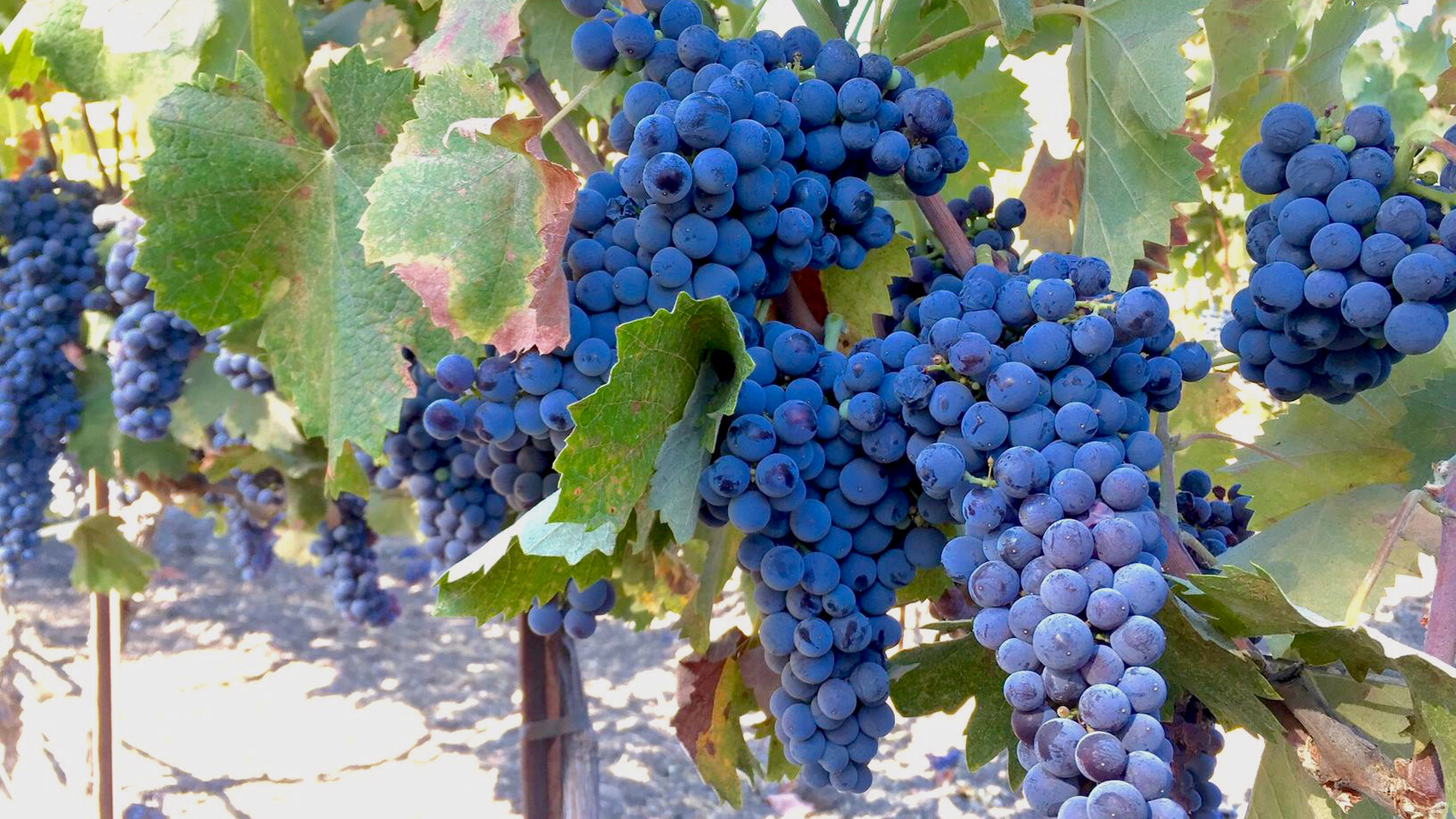
Mourvèdre
Mourvèdre, with its meaty richness and wonderful longevity, forms the backbone of our Esprit de Tablas. Twenty-one acres of our vineyard are devoted to Mourvèdre, representing the largest acreage of any of our grapes and over a third of our red Châteauneuf-du-Pape varieties.
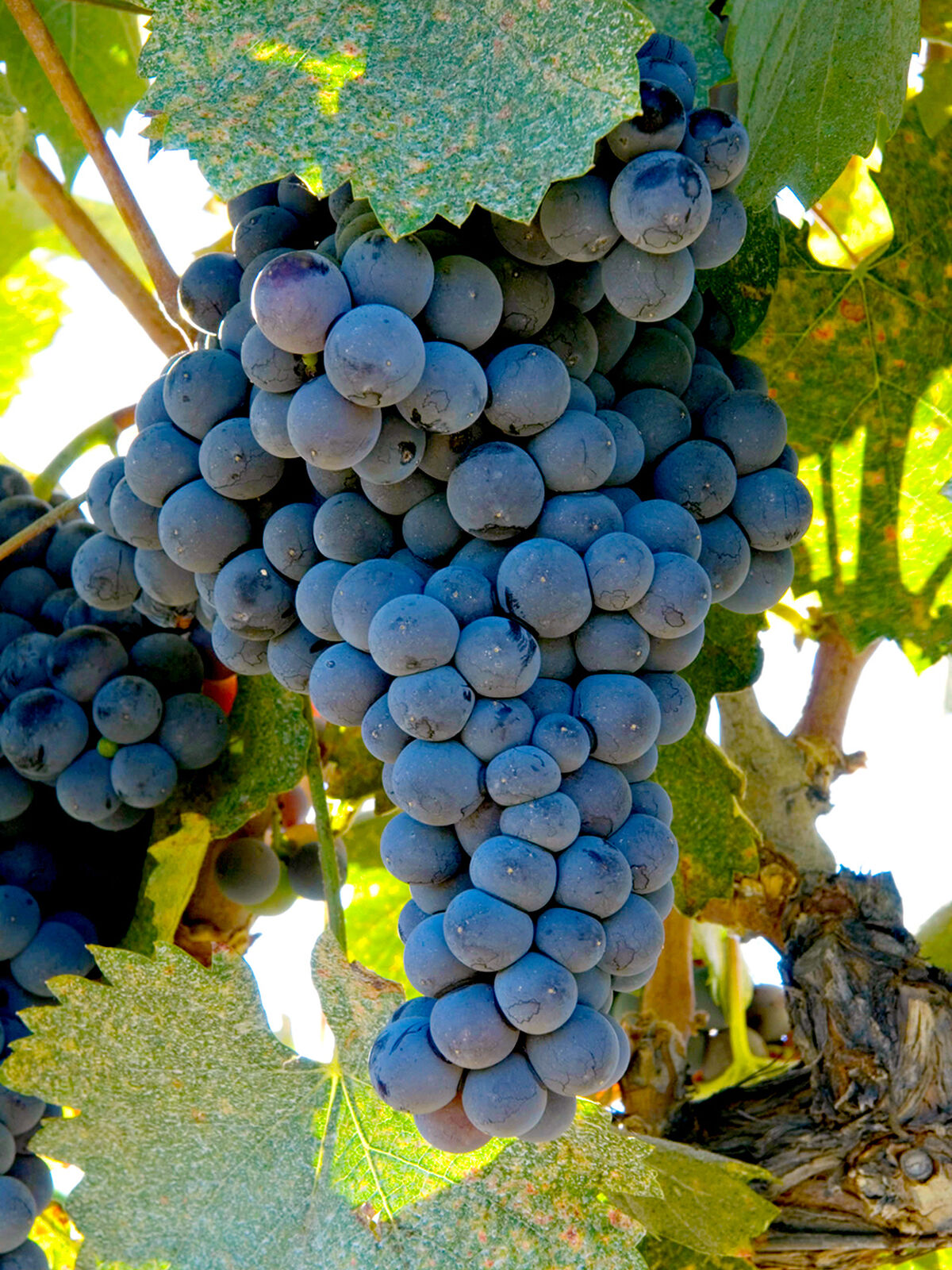
Early History
Mourvèdre is native to Spain, where it is known as Monastrell and where more than 80% of its worldwide acreage remains today. At over 102,000 acres, is second only to Grenache (Garnacha) in importance. From the Spanish town of Morvedre (now renamed Segunto) near Valencia, Mourvèdre was brought to Provence in the late Middle Ages where, prior to the phylloxera invasion at the end of the 19th century, it was the dominant varietal.
The phylloxera invasion was particularly devastating to Mourvèdre. Whereas most of the other Rhône varietals were easily matched with compatible rootstocks, Mourvèdre proved difficult to graft with the existing phylloxera-resistant rootstock. Thus, when the vineyards were replanted, most producers in Châteauneuf-du-Pape chose to replant with varieties that were easier to graft, such as Grenache. For decades, Mourvèdre was found in France almost exclusively in the sandy (and phylloxera-free) soil of Bandol, on the French Mediterranean coast, where it is bottled both as a red wine (blended with Grenache and Cinsault) and as perhaps the world's most coveted dry rosé.
Compatible rootstocks for Mourvèdre were developed only after World War II. Shortly thereafter, Jacques Perrin of Château de Beaucastel led regeneration efforts in Châteauneuf-du-Pape and made Mourvèdre a primary grape in the red Beaucastel wines. Since the late 1960s, total plantings in Southern France have increased dramatically, from a low of some 1,200 acres in 1960 to 21,000 acres as of 2016. But in Chateauneuf-du-Pape, which is 70% planted to Grenache, Mourvedre still plays a decidedly secondary role. Beaucastel is distinctive among Châteauneuf-du-Pape producers for using an unusually high percentage of Mourvèdre: up to 35% in some vintages.
Mourvèdre in the New World
Mourvèdre came to California as Mataro (a name taken from a town near Barcelona where the varietal was grown) in the mid to late 1800s. In California it was probably first established in Santa Clara County, although the oldest surviving vineyards are in Contra Costa County. It also found a home in Australia in the Barossa Valley. Until recently, the grape was rarely bottled by itself, and was instead generally used as a component of field blends. The increasing popularity and prestige of Rhône varietals, the importation of higher-quality clones (in which Tablas Creek played a role) and a return to the French Mourvèdre name has given the varietal a new life. As of 2025, there were 994 acres planted in California.
Mourvèdre was one of the initial eight grape varieties that we imported into the United States. While we were waiting for the vines to be released from USDA quarantine, we planted about two acres of the California-sourced Mataro clone near the top of our vineyard. We vinified the French and American clones separately, and found that Mourvedre showed the greatest disparity in quality. We grafted over the American-sourced vines to our French clones in 2003.
As of 2021, we have 25.9 acres of Mourvedre in production and another 7 acres under development at Tablas Creek, our largest footprint of any grape and more than one third of our total red acreage.
Mourvèdre in the Vineyard and Cellar
Mourvedre is late to sprout, late to flower, and late to ripen. That late bud break is helpful in our Paso Robles climate, where spring frosts can be a risk, and the late ripening is not a problem and can even be beneficial, as the fruit's last weeks on the vines typically happens in mid- to late-October, when days are short and nights chilly, keeping sugar accumulation slow and alcohols modest.
Mourvedre's upright growth pattern makes it particularly well suited to head-training. It is a relatively low vigor vine, with limited canopy, and trellising can expose Mourvedre clusters to sunburn. We try to keep its crop levels modest to maintain the vines' vigor, and still have to make multiple passes most years through our Mourvedre blocks, picking the ripest clusters from the healthiest vines and leaving the rest to ripen longer. Even with these multiple picks, our Mourvedre yields even in good years are typically below 2.5 tons/acre.
Mourvèdre is relatively easy-going in the cellar, and can be successfully fermented both in open-top fermenters with punch-downs, and in closed-top fermenters with pump-overs. In Bandol, it is typically fermented in whole clusters. In California, the stems of Mourvèdre often remain green into November, and we have felt that fermenting whole-cluster with green stems will make the resulting wine too tannic. However, in 2008, when a fluke October freeze lignified the stems of a Mourvèdre block, we took advantage by making a whole-cluster lot.
We typically press off our Mourvèdre after about 10 days of fermentation, and move it to large, neutral barrels. It is very well suited to aging in foudre, as it does not take particularly well to new oak, and does not have the same tendency toward reduction that Syrah does. We try to blend our Mourvèdre lots in the spring or summer after harvest, and then return the blends to foudre for an additional year of aging. Mourvèdre is a wonderful blending component; its structure and mid-palate richness complement the openness, warmth and brighter acids of Grenache and the mineral, spice and tannin of Syrah. It blends successfully both in a leading role (as in Bandol, or our Esprit de Tablas and Panoplie) as well as in a supporting role in our Grenache-based wines (as in Châteauneuf-du-Pape, or our Côtes de Tablas). In years when it gets fully ripe, it can also make a delicious single-varietal wine. We have bottled a varietal Mourvèdre most years since the 2003 vintage.
Mourvèdre is also a key component in some of the world's greatest rosés, most notably in Bandol, and we have used it as the base of our Dianthus rosé each year since 2012.
Flavors and Aromas
Wines made from Mourvèdre are intensely colored, rich and velvety with aromas of red fruit, chocolate/mocha, mint, leather, earth and game. They tend to be high in mid-palate tannin, and are well-suited to aging, although they are also often more approachable when young than the more overtly-tannic Grenache or Syrah.
In middle-age (anywhere from four to eight years after bottling) Mourvèdre-heavy wines often close down and become tight and unyielding. This closed period can last for as little as a year, or in extraordinary vintages as long as five years. When the wines reopen, the meaty flavors present in youth are complemented with aromas of forest floor, leather and truffles. The more intense a Mourvèdre-based wine is, the longer it stays open at the beginning, the longer it stays closed, and the longer it will drink well after it reopens.
This article originally appeared in one of our newsletters. Each newsletter, we spotlight the history and characteristics of one of our Rhone varietals. You can sign up for our mailing list.
You can view a one-minute summary of Mourvèdre on our YouTube page.
You can go back to the summaries of the different Rhône grape varietals.