
Grenache
Grenache, (also known as Grenache Noir, to distinguish it from its white counterpart Grenache Blanc) is the most widely planted grape in the southern Rhône Valley, and was at one point the second most widely planted grape world-wide (it's now seventh). It is most often blended, with Syrah and Mourvèdre in France and Australia, and with Tempranillo in Rioja, but reaches its peak in the wines of Châteauneuf-du-Pape, where it comprises 70%+ of the appellation’s acreage.
Early History
Grenache appears to have originated in Spain, most likely in the northern province of Aragon, and ampelographers believe that Grenache was the foundation of Aragon’s excellent vin rouge du pays. From Aragon, it spread throughout the vineyards of Spain and the Mediterranean in conjunction with the reach of the kingdom of Aragon, which at times included Roussillon and Sardinia. By the early 18th century, the varietal had expanded into Languedoc and Provence.
The phylloxera epidemic of the late 19th century indirectly increased European plantings of Grenache. In Rioja, for example, vineyards were replanted not with the native varietals, but with the hardy, easy to graft Grenache. A similar trend occurred in southern France, as the percentage of Grenache plantings after the phylloxera infestation increased significantly, replacing the previously abundant Mourvèdre. In 2000, it was the world's second-most-planted grape, with more than 500,000 acres worldwide.
In the last two decades, Grenache acreage has declined by about 30%, but it is still the seventh-most-planted grape worldwide. The decline has been steepest in Spain, where nearly half the 2000 acreage was gone by 2016, replaced with increased plantings of Cabernet, Merlot, Syrah, and Tempranillo. In 2016, France led the world with roughly 195,000 acres, followed by Spain (135,000 acres), Italy (13,000 acres), and China (10,000 acres).
Grenache was brought to California in the 1860s, where its erect carriage, vigor and resistance to drought made it a popular planting choice. It came to occupy second place in vineyard planting after Carignan and was an element in wine producers’ branded field blends. Unfortunately, most of this Grenache was planted in the Central Valley, cropped at very high levels, and the grape's reputation in California was poor. From a peak of just over 20,000 acres in 1974, Grenache plantings in California have declined steadily as the demand for bulk wine in the Central Valley has shifted toward Cabernet Sauvignon and Pinot Noir.
However, while bulk Grenache acreage was declining between 1974 and 2018, the variety was at the same time undergoing a surge in popularity among new producers and regions, with 2,000 new acres planted in high quality coastal appellations, the greatest concentration in Santa Barbara and San Luis Obispo counties. As of 2025 there were 4,187 acres planted in California.
Grenache at Tablas Creek
When we began Tablas Creek Vineyard in 1989, our dissatisfaction with the quality of California Grenache clones was a big driver of our decision to import new cuttings from Beaucastel, where Jacques Perrin had worked tirelessly to regenerate high quality Grenache vines. Those vines were put into quarantine in 1989, released to us in 1992, and planted in 1994. We have continued to add additional Grenache blocks, and it's 18.3 acres as of 2021 across twelve blocks is our second-largest footprint, after Mourvedre.
Grenache does need some vine age to show its best. So, it should perhaps have been unsurprising to us that it took us longer to become happy with our Grenache than than with any of our other varietals. Our initial expectations were that we would produce wines that were one-third or more Grenache, and we planted the vineyard accordingly. However, the early harvests of Grenache showed less depth that we wanted, and had aggressive front-palate tannins that were in striking contrast to the smoothness of Mourvedre and Syrah. It was only beginning in the 2005 vintage that we were really happy with the variety's performance, and only since 2006 that we've felt Grenache balanced enough to produce it as a varietal wine.
The percentage of Grenache in our Esprit de Tablas has ranged between 21% (in 2012) and 35% (in 2014 and 2017), and typically forms the second- or third-largest percentage, after Mourvedre and sometimes Syrah.
Grenache in the Vineyard and Cellar
Grenache is a vigorous variety with upright shoots that lends itself to “gobelet” or “head training”; it is widely cultivated in this manner in France and in Spain. At Tablas Creek, our newer Grenache plantings are mostly head trained; elsewhere on the vineyard, the varietal is cultivated in double cordon fashion with six fruiting canes, each with two buds. The varietal’s vigor gives it the potential to be a heavy producer. Despite our shoot thinning, we are usually obliged to fruit-prune during the growing seasons to keep the bunch count to ten or twelve clusters per vine. This practice means that we harvest between three and four tons of fruit per acre of vines.
Grenache ripens in the middle of the ripening cycle, after Syrah but before Counoise and Mourvedre. At harvest, it is notable for its high acidity even at relatively high sugar levels. In a typical year, we would begin to harvest Grenache at the end of September and finish in mid-October.
In the cellar, we typically ferment Grenache in closed stainless steel fermenters or large 1500-gallon wooden upright casks, to counteract Grenache's tendency toward oxidation. We avoid small 60-gallon barrels for Grenache for the same reason, and prefer to age Grenache-based wines in 1200-gallon oak foudres, whose thicker oak staves permit less oxygen to penetrate the wine.
Flavors and Aromas
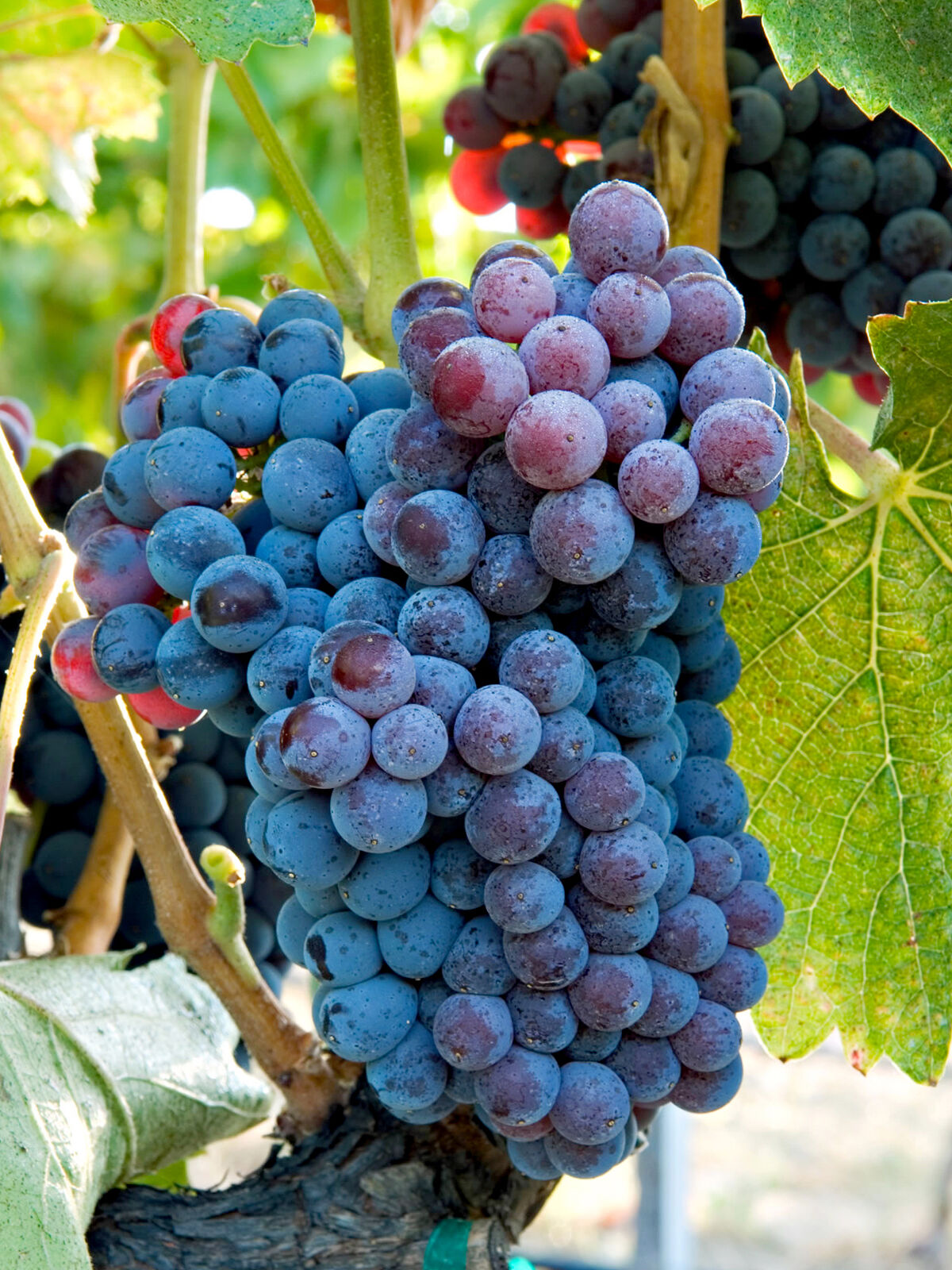
Grenache produces wines with high concentrations of fruit, tannin, and acids. Its flavors are most typically red currant and cherry, and its aromas are of black pepper, menthol, and licorice. Because Grenache is not a particularly dark or thick-skinned grape, wines tend to be brilliant translucent ruby in color, but they are intensely flavored nonetheless, often heady in alcohol (15% or higher), with powerful fruit highlighted by bright acids.
For our signature Mourvedre-based Esprit de Tablas and our Syrah-based Patelin de Tablas, Grenache is typically our #2 varietal and opens up those more closed, reductive varieties. The varietal can thrive in a lead role in a fruity, forward wine as in our Grenache-based Côtes de Tablas. We have also produced a varietal Grenache many years since 2006.
This article originally appeared in one of our newsletters. Each newsletter, we spotlight the history and characteristics of one of our Rhone varietals. You can sign up for our mailing list.
You can watch a one-minute video summary of Grenache on our YouTube page.
You can go back to the summaries of the different Rhône grape varietals.